
Huawei is reshaping China's car market, and it doesn't build a single vehicle
Gulf News
Gulf News
AI Summary
Huawei details its automotive strategy, focusing on supplying intelligent driving, smart cockpit, and vehicle control technology to partner brands. With over 2 million vehicles using its systems, the company is expanding its reach from China to markets like the UAE.
Huawei is best known in the UAE for its phones, wearables and laptops. In China, it is also becoming one of the most influential names in cars, without building a single one.
At a briefing at Huawei's Lianqiu Lake R&D campus in Shanghai's Qingpu district on 25 November, Marty Bian, Chief Marketing Officer of Huawei Consumer Business Group, Middle East & Africa, traced the strategy back seven years. “Back in 2019, we built this strategy entering the automotive industry, and in 2021 we started commercialisation,” he said. “So this year is the sixth year since we first announced this intelligent automotive strategy.”
Instead of making vehicles, Huawei supplies the technology inside them to partner carmakers. Huawei has continued to invest significantly in automotive research and development, with a focus on intelligent driving, smart cockpits, vehicle control and connected services. Huawei's presentation put its automotive R&D team at 8,000 engineers, working with more than 600 industry partners.
Huawei says more than 2 million vehicles now run its driver-assistance system. It holds a 27.9 per cent share of China's city navigation assist market, the technology that guides a car through urban streets. In cars priced above 350,000 yuan (about Dh190,000), its share is 51.6 per cent.
“We take more than half of the market share in the 350,000-yuan-plus segment,” Marty said. The company also shipped 36.18 million automotive components in 2025.
Huawei's automotive technology portfolio covers five key areas. At its core is the Huawei Advanced Driving System, which uses lidar, millimetre-wave radar and high-definition cameras to give cars what he described, in simple terms, as “assisted driving”.
Alongside it sits Harmony Space, the in-car software built on HarmonyOS, which Marty said has passed 100 million users in China. “We are not only a hardware company; we also develop software for HarmonyOS,” he said.
Under the body, Huawei's vehicle control technology links steering, suspension, motors and batteries, helping coordinate key vehicle systems to enhance responsiveness and driving performance. On the optics side, the company supplies heads-up displays and headlights that can double as a projector. “With our car, you can actually use the car light as a projector, so you can watch a movie at night,” he said. Inside, a paper-matte screen borrowed from Huawei's tablets “will reduce the glare and reflection by 97 per cent”, Marty said.
The fifth part is sound and cloud services. The top Huawei Sound package has 43 speakers and amplifiers of up to 3,000 watts. These audio technologies are designed to deliver a more immersive and personalised in-car entertainment experience.
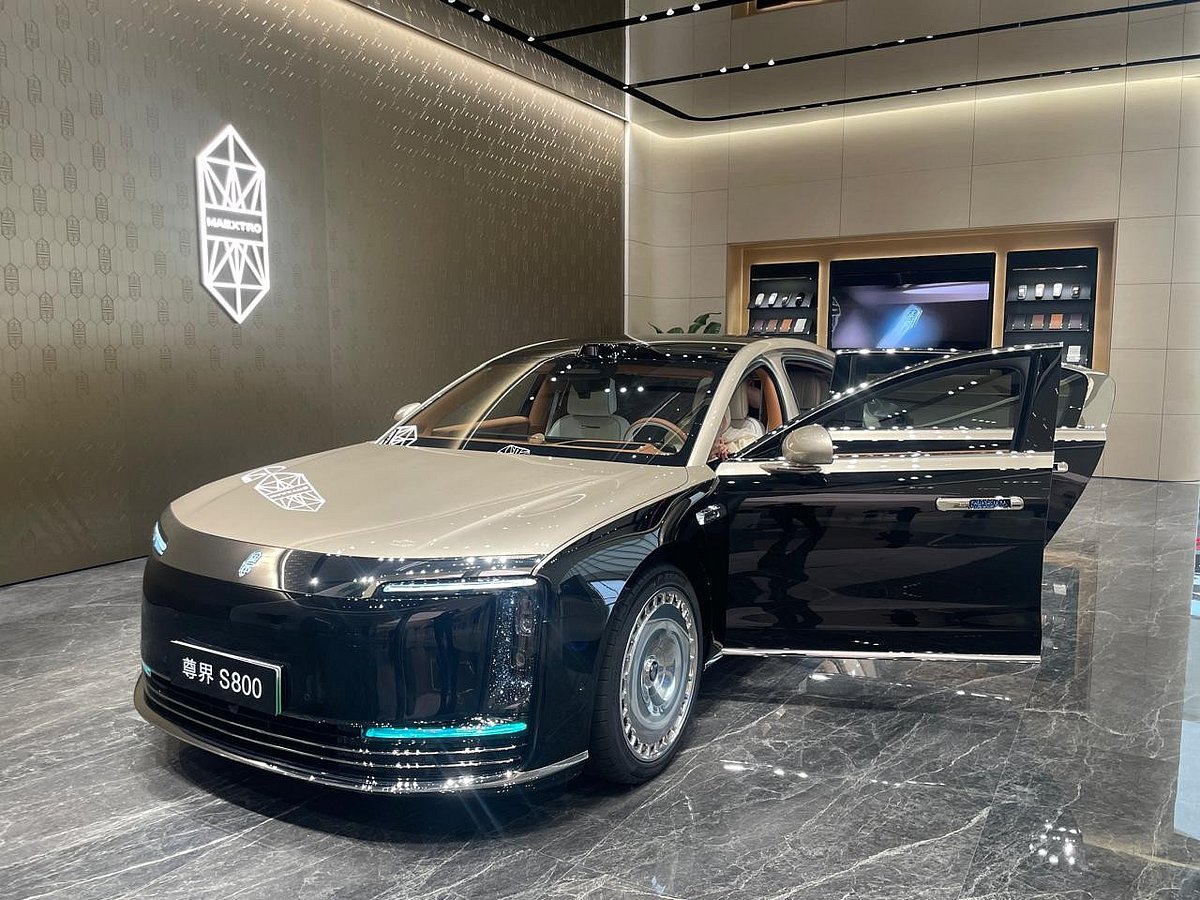
Huawei's main vehicle partnership is the Harmony Intelligent Mobility Alliance, which covers five brands: Aito with Seres, Luxeed with Chery, Stelato with BAIC, Maextro with JAC and Shangjie with SAIC. Avatr, built with Changan and CATL, works closely with Huawei but sits outside the alliance.
UAE drivers are among the first outside China to meet vehicles developed by Chinese automotive brands working with Huawei. Avatr launched in Dubai in late 2024 through Smart Mobility International. The UAE was its first export market, with the Avatr 11 and Avatr 12 leading the line-up and a showroom announced for Sheikh Zayed Road.
Marty said safety was central to the pitch. “The average mileage driven before a severe collision, we are 5.75 times higher than manual driving average,” he said. “Even when you are driving manually, when you are not using the assisted driving, it will help protect you.”
The partner brands are preparing a wave of new models, and Marty said Huawei's ambitions go well beyond China's roads. For UAE drivers, that future has already begun to arrive. The aim, he said, is “to bring intelligence to every vehicle”.
Sentiment analysis
AI insights
Low
1h ago
General
—
Financial analysis
Relevance
Medium
Market sensitivity
Medium
Affected sectors
Affected assets
Follow this story on TV
Live charts and AI commentary on one screen with Trade on tv.